
Only logged in customers who have purchased this product may leave a review.
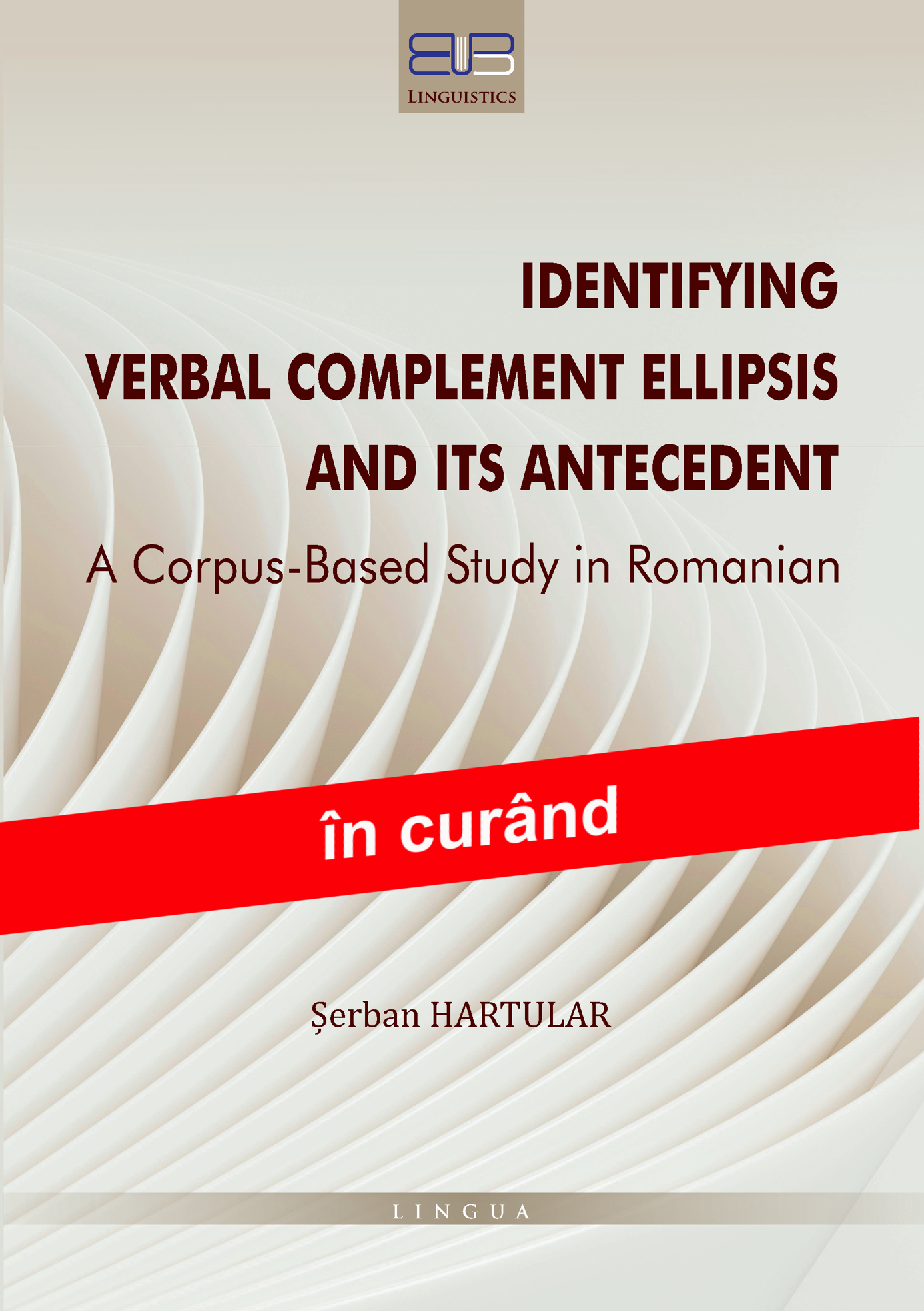
IDENTIFYING VERBAL COMPLEMENT ELLIPSIS AND ITS ANTECEDENT: A CORPUS-BASED STUDY IN ROMANIAN
- Autor: Șerban HARTULAR
- An aparitie: 2026
- Numar de pagini: 202
- Format: B5
- ISBN: 978-606-16-1676-3
- Limba textului: engleză
Ellipsis has been studied primarily as a syntactic phenomenon. Nevertheless, a defining (and, in our opinion, the most intriguing) characteristic of ellipsis is that it constitutes a means of communicating linguistic material without phonetic form. This book examines two issues that arise in recovering this unpronounced linguistic information: recognizing that an utterance is elliptic in the first place, and identifying the correct antecedent, both vital to the recovery of the elided material. Although examples in the literature commonly treat these two data as given, an examination of ellipsis as it appears in corpora (this book is concerned specifically with the ellipsis of clausal complements in Romanian) reveals that matters are not nearly as straightforward as isolated examples may suggest. A verb that requires a (clausal) complement can appear in the absence of that complement in a variety of situations, many of which are not actually ellipses. Additionally, for this type of ellipsis, the position of the antecedent relative to the site of the ellipsis is not subject to any obvious constraints.
As a result, every verb phrase present in the context where an ellipsis of this type appears is a possible antecedent of that ellipsis. However, despite these potential sources of ambiguity, in every case we examined, neither the fact that a construction was elliptic, nor the identity of the antecedent were in doubt, as long as the context that the ellipsis appeared in was known. This suggests that there must exist a common convention, a set of rules, that allows a (possibly) elliptic statement to be interpreted as the speaker intended.
Our study concludes that the key to answering these questions is to consider the process of integrating an (elliptic) statement into discourse, by establishing local discourse coherence relationships (Kehler 2002) that tie statements to each other in succession, while keeping in mind the requirement that the statements in a discourse contribute to the goal of answering a question under discussion or QUD (Roberts 2012 [1996]). The receiver of an elliptic statement selects the antecedent that allows a discourse coherence relationship to be established between the statement that contains the antecedent and the elliptic statement (or, if the antecedent is exophoric, selects the antecedent from QUD), i.e., the choice that ensures discourse coherence. Non-elliptic interpretations of structures where an elidable complement is missing correspond to situations where an elliptic interpretation of the same structure would make establishing a discourse coherence relationship semantically impossible.
Related products
-

ROMANIAN CULTURAL AND LITERARY STUDIES. VOL II. STUDIES OF ROMANIAN LITERATURE. 20TH CENTURY
38,06 lei Read more -
ETYMOLOGICAL DICTIONARY OF NEOLOGICAL ANTONYMS
42,29 lei Read more -

PAPERS OF THE THIRD INTERNATIONAL LINGUISTICS SYMPOSIUM
59,62 lei Add to cart -

TERMINOLOGY AND TERMINOLOGIES
33,83 lei Read more
Reviews
There are no reviews yet.