
Only logged in customers who have purchased this product may leave a review.
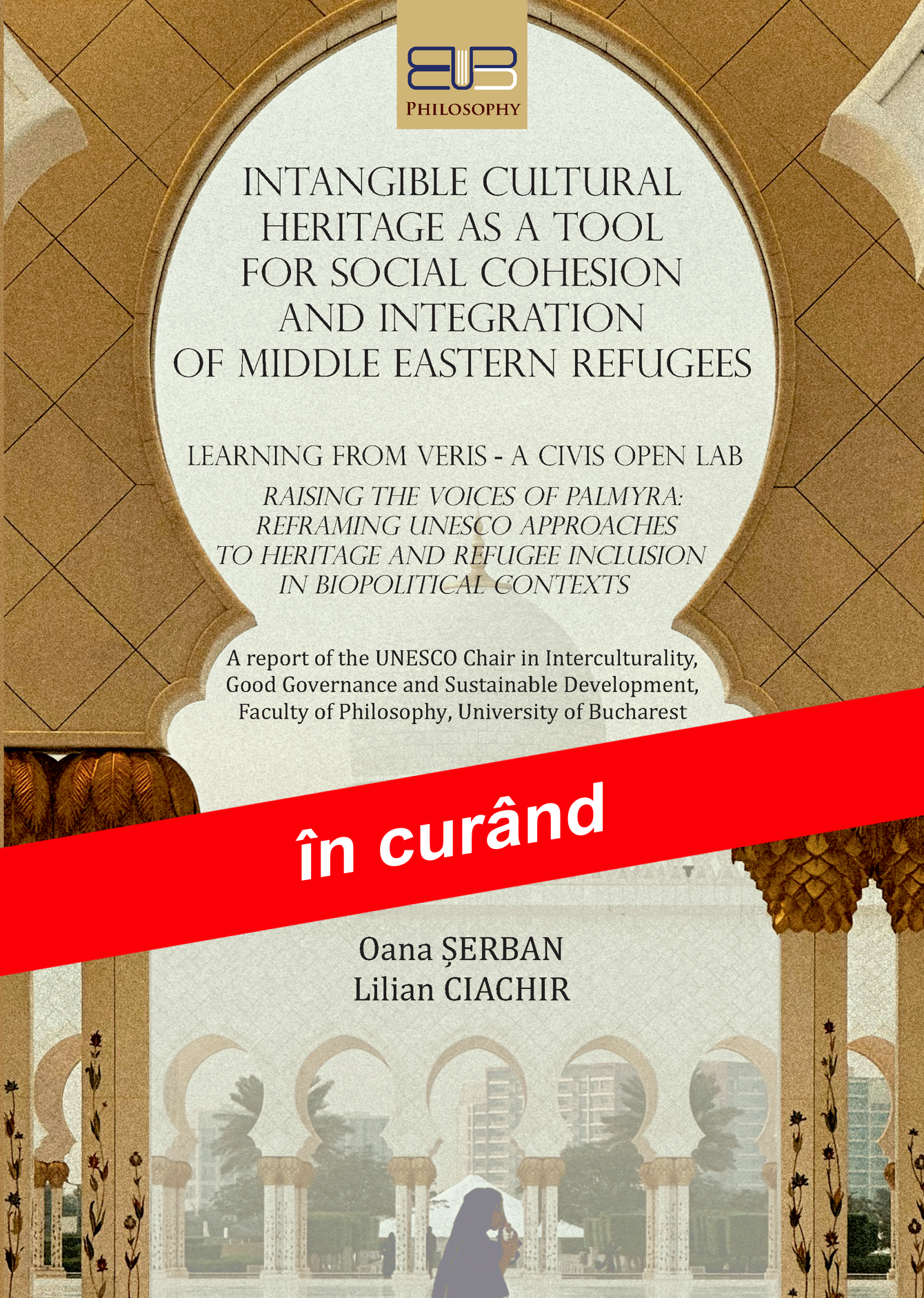
INTANGIBLE CULTURAL HERITAGE AS A TOOL FOR SOCIAL COHESION AND INTEGRATION OF MIDDLE EASTERN REFUGEES
- Autor: Oana ȘERBAN, Lilian CIACHIR
- An aparitie: 2026
- Numar de pagini: 84
- Format: B5
- ISBN: 978-606-16-1762-3
- Limba textului: engleză
Learning from VERIS – A CIVIS Open Lab Raising the Voices of Palmyra: Reframing UNESCO Approaches to Heritage and Refugee Inclusion in Biopolitical Contexts A report of the UNESCO Chair in Interculturality, Good Governance and Sustainable Development, Faculty of Philosophy, University of Bucharest Over two years of research within VERIS – Voices of Palmyra: Engaging (In)tangible Memorial Heritage in Social Innovation for Refugee Inclusion, a CIVIS Open Lab coordinated by Patrick M. Michel (University of Lausanne), Oana Șerban (University of Bucharest), and Brittnee Leysen (University of Glasgow), we have documented how the virtual reality reconstruction of destroyed tangible cultural heritage (TCH), particularly in contexts shaped by terrorist violence and biopolitical regimes of exclusion and atrocity, helps displaced persons, refugees, and minority communities re-engage with their identities and work through uprootedness. We conclude that the intangible cultural heritage (ICH) entangled with such heritage must be reconceived beyond symbolic recognition: it constitutes a field of rights, participation, and institutional justice. Practiced as corrective justice, ICH can expose the historical processes and ideologies that produced marginality, hatred, and discrimination, reconfiguring the normative field in which UNESCO brings together TCH and ICH for social inclusion within a biopolitical framework. The core contribution of this report is a participatory
justice model for UNESCO-oriented ICH governance, specifying the institutional conditions under which refugees can participate as peers in defining, safeguarding, transmitting, and transforming heritage. Cultural initiatives achieve durable inclusion only when they move beyond visibility and recognition to democratise heritage governance itself, enabling refugees to act as co-authors of the orders that shape their lives.
Related products
-

Analytical Philosophy Review, vol.II, no. 1, January – June 2008
19,01 lei Read more -

Analytical Philosophy Review, vol.II, no. 2, July – December 2008
21,14 lei Read more -

BEING AND THE HYPERVERSE. AN AXIOMATIC-HYPERONTOLOGICAL FRAMEWORK FOR EPISTEMOLOGICALLY DIFFERENT WORLDS
32,77 lei Add to cart -

HERMETIC TRANSPARENCY
26,43 lei Add to cart
Reviews
There are no reviews yet.